Showing posts with label market. Show all posts
Showing posts with label market. Show all posts
Aug 14, 2009
Shock Jocks:0 - Common Sence:1
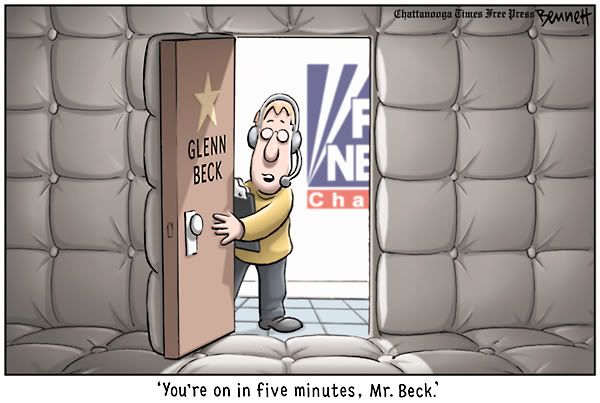
Thank God, finally at least one of the Faux's programs is reaping the fruits ot its shock-jocks' insane attempts to sabotage THE AMERICAN DEMOCRATIC PROCESS! I'm talking of course about the loss of advertisers to the show of the poster child of the "Fear & Smear" attack force, Glenn Beck. My guess is now they will start accusing The President in controlling the corporations by voodoo.


Aug 13, 2009
Best In The World? Says Who?
Yesterday, as I was driving home I caught a piece of a report on the radio from one of the town hall meetings on health care. One of the sound bites was an "angry citizen" lady, pointing out that we have "the best health care on the world" and also that "people all over the world come here to get treatment".
This is the same as claiming that we have the best diet in the world, based on the fact that some people in America have private chefs and nutritionists. There is no question that if you have money you can get the absolute best of everything. That is true in America, as well as everywhere else in the industrialized world. So the honest version of that "angry citizen" lady's statement would be that we have "the best in the world medical services for able to pay people" and "people all over the world, who can afford it, come here to get special treatment". The wealthy never go through the system, common to everyone else, so the fact that let's say a well-to-do Canadian comes to US to see a highly recommended specialist is not really a compliment for the US health care system. If everyone was rich or at least upper-middle class, we would not need any "system" - health care, retirement, social services, etc. The system (health care or other) is for the lower-middle class and the poor, who are the majority of the population. That's the way it is in every country in the industrialized world - there is a basic accessible service for everyone, and whoever does not care for it does not have to use it.
As far as the "best in the world health care system" claim, it's plain untrue, but that's not really why the "angry citizens'" are angry about, is it...
This is the same as claiming that we have the best diet in the world, based on the fact that some people in America have private chefs and nutritionists. There is no question that if you have money you can get the absolute best of everything. That is true in America, as well as everywhere else in the industrialized world. So the honest version of that "angry citizen" lady's statement would be that we have "the best in the world medical services for able to pay people" and "people all over the world, who can afford it, come here to get special treatment". The wealthy never go through the system, common to everyone else, so the fact that let's say a well-to-do Canadian comes to US to see a highly recommended specialist is not really a compliment for the US health care system. If everyone was rich or at least upper-middle class, we would not need any "system" - health care, retirement, social services, etc. The system (health care or other) is for the lower-middle class and the poor, who are the majority of the population. That's the way it is in every country in the industrialized world - there is a basic accessible service for everyone, and whoever does not care for it does not have to use it.
As far as the "best in the world health care system" claim, it's plain untrue, but that's not really why the "angry citizens'" are angry about, is it...
Aug 4, 2009
The "Cash For Clunkers" Lemon

Let's just get down to business and pick apart this well-intentioned but ill-conceived attempt for stimulus:
One of the stipulations for eligibility is that you have to prove that the clunker you are trading in was CONTINUOUSLY insured going back a full year from the day of the trade.
What brain dead bureaucrat came up with that?!?!?!
This means that unless the clunker is your only car, which you've had for years, you don't qualify. Here is a short incomplete list of people who fit this profile:
pickup truck enthusiasts, roadsters' enthusiasts, boat owners, hobby mechanics, people on welfare, retired people, weekend drivers, people who oppose having a car payment, people with bad credit... All these either are not interested in trading their old car, or can not afford to buy a new car or both. A lot of poor people who would gladly trade their clunker, simply can't afford a new car payment, sales tax, new tags, and full coverage insurance, which is mandatory when financing is used to buy a new car.
People who don't qualify include:
1. Economically pressed people, who got the clunker 11 months ago from their aunt, who had it sitting in the garage uninsured for the past year.
2. Spouses, who had to go back to work because of the economic crash last fall, and had to start driving the clunker to work. Those clunkers were not on the road a year ago. Furthermore, remember how before the economic crash last Fall the clunkers values were driven down by the high gas prices? A lot of people simply sat on the clunkers, because they could not sell them for a fair price and could not afford to drive them, and now are driving them full time once again, since the gas prices are bearable.
3. Folks who got laid off and had to take their car off the road for a couple of months to save the expenses they could not afford. Now, if they have found another job and are driving the clunker once again, they are being punished for trying to make the ends meet.
4. People who missed insurance payment for couple of months, because they were in a hospital, work assignment, or whatever, and now have 30 or 60 day gap in their 15 year continuous insurance.
5. Deployed military personnel.
Way to go, ingenious bureaucrats!

May 8, 2009
Comercial-Free?!?
 Using advertisement for advertisement-free online video to adverise.
 Just like ... s**t-free poop of a crap. It's not waste - it's bi-product, and "bi" means we are getting double the value and that's good, right?
My $0.02: Please, just advertise. Stop trying to trick us - we live in the same world and we know what you are up to. If you are going to annoy us, please have the courtesy not to try to make it sound like it's for our benefit. Just show your banners and promos as usual. Don't try to sneak up on us, trying to catch us off-guard. That only works once. With TV there was not much choice - you see an annoying ad popping up in unusual spot - you flip around the channels and if there is nothing else better than what you were watching you eventually come back to it.
Internet offers a lot more choices. Like for example now - I see this clever turd (see the picture) pushed at me while watching something online, and I leave immediately to blog about what I think of it. While I do that, I carefully make sure to hide all the brands, I personally make point not to watch at the advertised time, and I also tell everyone I know not to do it. Unlike with TV - you can't count on me to come back for lack of better things to do online - there is always something else interesting on the Internet. Always! And with the short attention span, well cultivated by years of watching TV, cluttered with obtrysive adverisement, chances are I won't even think for going back at least for couple of days. Or ever.
Now, what was it you were selling?
May 4, 2009
Extra Delivery Charges
Last night, we ordered a pizza. When the pizza got delivered, the Domino's delivery guy unilaterally decided to increase the price because he "drove 10 miles to get here" and he will be "loosing money" if he does not charge extra for the delivery. This came totally unexpected. Usually we pay whatever the price is and give tip on top of that. Keep in mind that there is an explicit delivery charge over the price of the order, which is charged at the time of ordering and the delivery guy's "charge" came on top of that and before of course his tip...
The fact that it was Domino's is irrelevant in this situation, although they could benefit from not annoying their customers so soon after the bad publicity they got just few days ago.
I understand the delivery guy's desire to make more money but the way he chose to do that I find absolutely inappropriate not to mention that this guy had caused Domino's to loose us as customers. We wanted to give them a break, after the YouTube video with Domino's employees grossly mishandling food came out, but we draw the line above paying phony charges.
So, next time you order a pizza, make sure you ask about any additional charges that might be imposed by the delivery person. It will save you few dollars but most impotantly, the annoying feeling that you are being taken.
The fact that it was Domino's is irrelevant in this situation, although they could benefit from not annoying their customers so soon after the bad publicity they got just few days ago.
I understand the delivery guy's desire to make more money but the way he chose to do that I find absolutely inappropriate not to mention that this guy had caused Domino's to loose us as customers. We wanted to give them a break, after the YouTube video with Domino's employees grossly mishandling food came out, but we draw the line above paying phony charges.
So, next time you order a pizza, make sure you ask about any additional charges that might be imposed by the delivery person. It will save you few dollars but most impotantly, the annoying feeling that you are being taken.
Apr 22, 2009
The meaning of "Car Culture"
"... there are many auto-industry executives who maintain that the [electric cars] hype has gotten well ahead of reality. There is no infrastructure, in the form of battery-charging stations, to support pure electric models ..." (times.com)
The skeptical opinions towards the market's readiness for electric cars (and new technology in general) all have a major problem: they all assume that driving patterns and people's needs will stay the same as they have been for the last 50-60 years. While nobody can also predict the opposite, the past suggests some conclusions about people’s attitudes towards new technologies.
Let's think about the meaning of the term "Car Culture". During the last 100 or so years, people have created a lifestyle around the availability of a new technology (cars). When the internal combustion powered cars were still a novelty, only the geeks, eccentrics, and adventurers were excited about them. The traditional view was that they are dirty, noisy, dangerous, and with limited application. And they had a point - back then life was different. For a while horse-drawn buggies and cars shared the roads until people decided they prefer noisy, dirty, and dangerous cars than a horse which was considered mainstream and most suitable for the existing lifestyle. Putting everybody in cars probably seemed pretty far-fetched.
Now, just like then, we have a brand new technology available, which is somewhat of a novelty and does not quite fit our traditional lifestyle. Today's skeptics, just like the ones 100 or so years ago just can't imagine that lifestyles and consumer culture change faster than expected. Newspapers are going away, smoking is not popular anymore, online social networking was not even invented few years ago and now people are making expensive business decisions and planning their careers based on its specifics.
The only concern car makers should have is building and selling a product with what's available today at a reasonable price. Let the market decide if they like it and how to use it.
And enough with the charging stations nonsense argument - electricity is available everywhere. The same goes for "experts" saying that the grid won't handle the load. The only expertise that goes into a statement like that is in short sight. How did the grid successfully adjust to handle the inventions of the electric dryers, freezers, and air-conditioners, and why is charging a battery any bigger challenge than that?
The skeptical opinions towards the market's readiness for electric cars (and new technology in general) all have a major problem: they all assume that driving patterns and people's needs will stay the same as they have been for the last 50-60 years. While nobody can also predict the opposite, the past suggests some conclusions about people’s attitudes towards new technologies.
Let's think about the meaning of the term "Car Culture". During the last 100 or so years, people have created a lifestyle around the availability of a new technology (cars). When the internal combustion powered cars were still a novelty, only the geeks, eccentrics, and adventurers were excited about them. The traditional view was that they are dirty, noisy, dangerous, and with limited application. And they had a point - back then life was different. For a while horse-drawn buggies and cars shared the roads until people decided they prefer noisy, dirty, and dangerous cars than a horse which was considered mainstream and most suitable for the existing lifestyle. Putting everybody in cars probably seemed pretty far-fetched.
Now, just like then, we have a brand new technology available, which is somewhat of a novelty and does not quite fit our traditional lifestyle. Today's skeptics, just like the ones 100 or so years ago just can't imagine that lifestyles and consumer culture change faster than expected. Newspapers are going away, smoking is not popular anymore, online social networking was not even invented few years ago and now people are making expensive business decisions and planning their careers based on its specifics.
The only concern car makers should have is building and selling a product with what's available today at a reasonable price. Let the market decide if they like it and how to use it.
And enough with the charging stations nonsense argument - electricity is available everywhere. The same goes for "experts" saying that the grid won't handle the load. The only expertise that goes into a statement like that is in short sight. How did the grid successfully adjust to handle the inventions of the electric dryers, freezers, and air-conditioners, and why is charging a battery any bigger challenge than that?
Subscribe to:
Posts (Atom)